Note
Go to the end to download the full example code.
03. Pseudoinverse solution from linear measurements
This tutorial shows how to simulate measurements and perform image reconstruction using the spyrit.core.inverse.PseudoInverse class of the spyrit.core.inverse submodule.
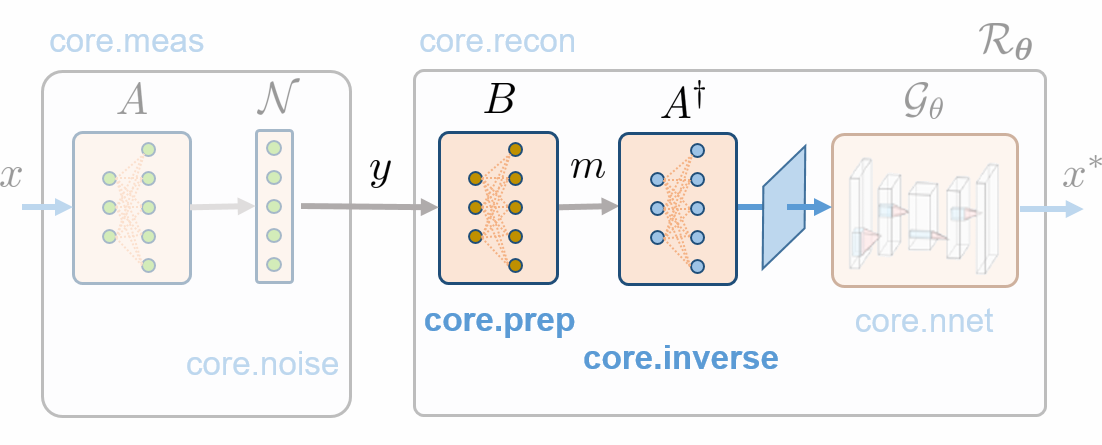
Loads images
We load a batch of images from the /images/ folder. Using the
spyrit.misc.statistics.transform_gray_norm() function with the normalize=False
argument returns images with values in (0,1).
import os
import torchvision
import torch.nn
from spyrit.misc.statistics import transform_gray_norm

spyritPath = os.getcwd()
imgs_path = os.path.join(spyritPath, "images/")

# Grayscale images of size 32 x 32, no normalization to keep values in (0,1)
transform = transform_gray_norm(img_size=64, normalize=False)

# Create dataset and loader (expects class folder 'images/test/')
dataset = torchvision.datasets.ImageFolder(root=imgs_path, transform=transform)
dataloader = torch.utils.data.DataLoader(dataset, batch_size=7)

x, _ = next(iter(dataloader))
print(f"Ground-truth images: {x.shape}")
Ground-truth images: torch.Size([7, 1, 64, 64])
Linear measurements without noise
We consider a Hadamard matrix in “2D”. The matrix has a shape of (64*64, 64*64)and values in {-1, 1}.
from spyrit.core.torch import walsh_matrix_2d

H = walsh_matrix_2d(64)

print(f"Acquisition matrix: {H.shape}", end=" ")
print(rf"with values in {{{H.min()}, {H.max()}}}")
Acquisition matrix: torch.Size([4096, 4096]) with values in {-1.0, 1.0}
We instantiate a spyrit.core.meas.Linear operator. To indicate that the operator works in 2D, on images with shape (64, 64), we use the meas_shape argument.
We simulate the measurement vectors, which have a shape of (7, 1, 4096).
y = meas_op(x)

print(f"Measurement vectors: {y.shape}")
Measurement vectors: torch.Size([7, 1, 4096])
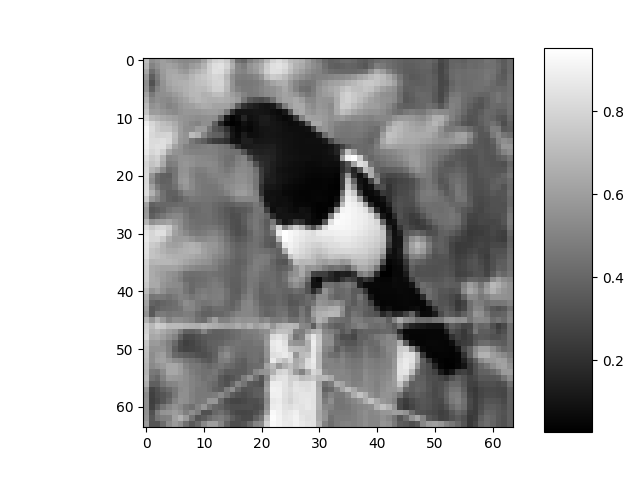
We now compute the pseudo inverse solutions, which have a shape of (7, 1, 64, 64).
from spyrit.core.inverse import PseudoInverse

pinv = PseudoInverse(meas_op)
x_rec = pinv(y)

print(f"Reconstructed images: {x_rec.shape}")
Reconstructed images: torch.Size([7, 1, 64, 64])
We plot the reconstruction of the second image in the batch
/home/docs/checkouts/readthedocs.org/user_builds/spyrit/envs/3.0.1/lib/python3.11/site-packages/matplotlib/cbook.py:684: DeprecationWarning: __array__ implementation doesn't accept a copy keyword, so passing copy=False failed. __array__ must implement 'dtype' and 'copy' keyword arguments. To learn more, see the migration guide https://numpy.org/devdocs/numpy_2_0_migration_guide.html#adapting-to-changes-in-the-copy-keyword
  x = np.array(x, subok=True, copy=copy)
Note
The measurement operator is chosen as a Hadamard matrix with positive but this matrix can be replaced by any other matrix.
LinearSplit measurements with Gaussian noise
We consider a linear operator where the positive and negative components are split, i.e. acquired separately. To do so, we instantiate a spyrit.core.meas.LinearSplit operator.
from spyrit.core.meas import LinearSplit

meas_op = LinearSplit(H, (64, 64))
We consider additive Gaussian noise with standard deviation 2.
from spyrit.core.noise import Gaussian

meas_op.noise_model = Gaussian(2)
We simulate the measurement vectors, which have shape (7, 1, 8192).
y = meas_op(x)

print(f"Measurement vectors: {y.shape}")
Measurement vectors: torch.Size([7, 1, 8192])
We preprocess measurement vectors by computing the difference of the positive and negative components of the measurement vectors. To do so, we use the spyrit.core.prep.Unsplit class. The preprocess measurements have a shape of (7, 1, 4096).
Preprocessed measurement vectors: torch.Size([7, 1, 4096])
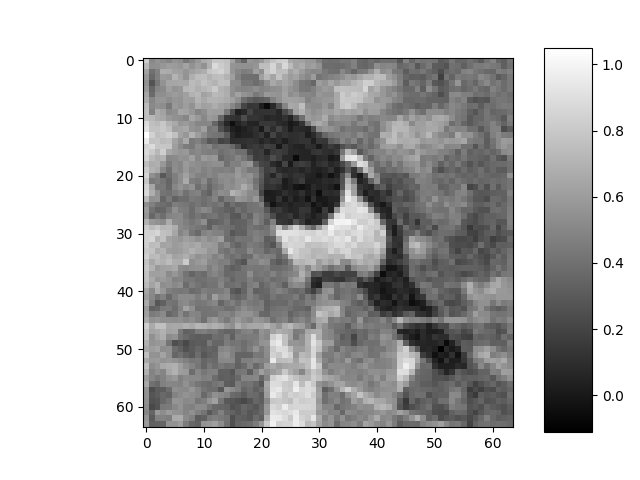
We now compute the pseudo inverse solutions, which have a shape of (7, 1, 64, 64).
from spyrit.core.inverse import PseudoInverse

pinv = PseudoInverse(meas_op)
x_rec = pinv(m)

print(f"Reconstructed images: {x_rec.shape}")
Reconstructed images: torch.Size([7, 1, 64, 64])
We plot the reconstruction
/home/docs/checkouts/readthedocs.org/user_builds/spyrit/envs/3.0.1/lib/python3.11/site-packages/matplotlib/cbook.py:684: DeprecationWarning: __array__ implementation doesn't accept a copy keyword, so passing copy=False failed. __array__ must implement 'dtype' and 'copy' keyword arguments. To learn more, see the migration guide https://numpy.org/devdocs/numpy_2_0_migration_guide.html#adapting-to-changes-in-the-copy-keyword
  x = np.array(x, subok=True, copy=copy)
HadamSplit2d with x4 subsampling with Poisson noise
We consider the acquisition of the 2D Hadamard transform of an image, where the positive and negative components of acquisition matrix are acquired separately. To do so, we use the dedicated spyrit.core.meas.HadamSplit2d operator. It also allows for subsampling the rows the Hadamard matrix, using a sampling map.
from spyrit.core.meas import HadamSplit2d

# Sampling map with ones in the top left corner and zeros elsewhere (low-frequency subsampling)
sampling_map = torch.ones((64, 64))
sampling_map[:, 64 // 2 :] = 0
sampling_map[64 // 2 :, :] = 0

# Linear operator with HadamSplit2d
meas_op = HadamSplit2d(64, 64**2 // 4, order=sampling_map, reshape_output=True)
We consider additive Poisson noise with an intensity of 100 photons.
from spyrit.core.noise import Poisson

meas_op.noise_model = Poisson(100)
We simulate the measurement vectors, which have a shape of (7, 1, 2048)
Note
The spyrit.core.noise.Poisson class noise assumes that the images are in the range [0, 1]
y = meas_op(x)

print(rf"Reference images with values in {{{x.min()}, {x.max()}}}")
print(f"Measurement vectors: {y.shape}")
Reference images with values in {0.003921568859368563, 0.9960784316062927}
Measurement vectors: torch.Size([7, 1, 2048])
We preprocess measurement vectors by i) computing the difference of the positive and negative components, and ii) normalizing the intensity. To do so, we use the spyrit.core.prep.UnsplitRescale class. The preprocessed measurements have a shape of (7, 1, 1024).
from spyrit.core.prep import UnsplitRescale

prep = UnsplitRescale(100)

m = prep(y)  # (y+ - y-)/alpha
print(f"Preprocessed measurement vectors: {m.shape}")
Preprocessed measurement vectors: torch.Size([7, 1, 1024])
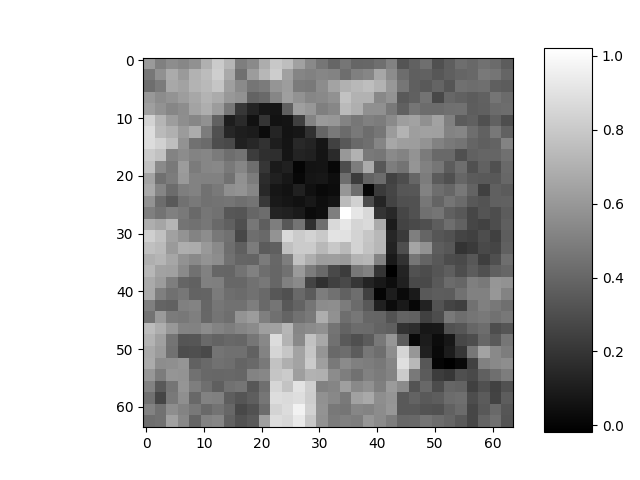
We compute the pseudo inverse solution, which has a shape of (7, 1, 64, 64).
x_rec = meas_op.fast_pinv(m)

print(f"Reconstructed images: {x_rec.shape}")
Reconstructed images: torch.Size([7, 1, 64, 64])
Note
There is no need to use the spyrit.core.inverse.PseudoInverse class here, as the spyrit.core.meas.HadamSplit2d class includes a method that returns the pseudo inverse solution.
We plot the reconstruction
/home/docs/checkouts/readthedocs.org/user_builds/spyrit/envs/3.0.1/lib/python3.11/site-packages/matplotlib/cbook.py:684: DeprecationWarning: __array__ implementation doesn't accept a copy keyword, so passing copy=False failed. __array__ must implement 'dtype' and 'copy' keyword arguments. To learn more, see the migration guide https://numpy.org/devdocs/numpy_2_0_migration_guide.html#adapting-to-changes-in-the-copy-keyword
  x = np.array(x, subok=True, copy=copy)
Total running time of the script: (0 minutes 18.806 seconds)