Note
Go to the end to download the full example code.
02. Pseudoinverse solution from linear measurements
This tutorial shows how to simulate measurements and perform image reconstruction. The measurement operator is chosen as a Hadamard matrix with positive coefficients. Note that this matrix can be replaced by any desired matrix.
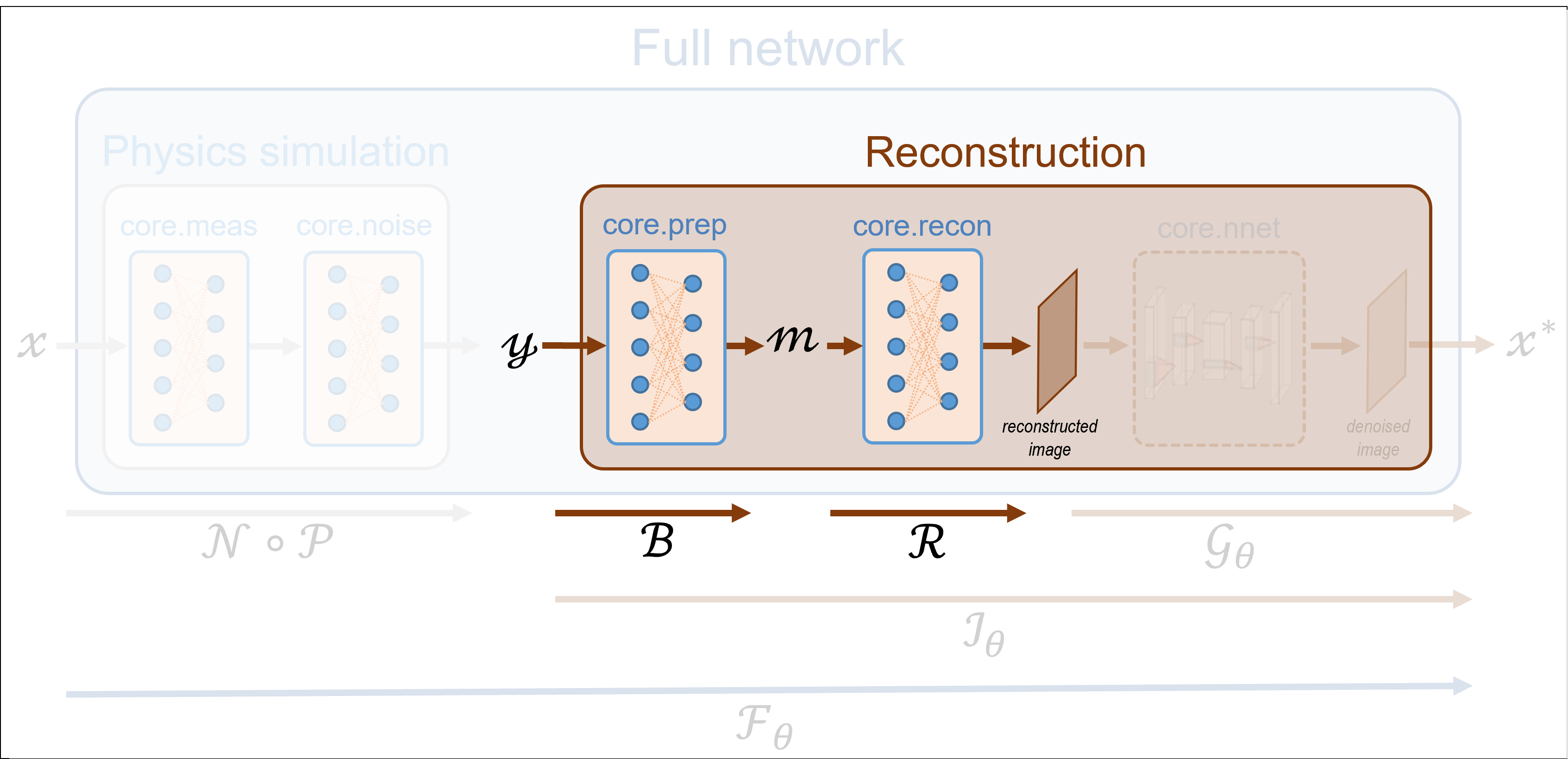
These tutorials load image samples from /images/.
Load a batch of images
Images \(x\) for training expect values in [-1,1]. The images are normalized
using the transform_gray_norm() function.
import os

import torch
import torchvision

import spyrit.core.torch as spytorch
from spyrit.misc.disp import imagesc
from spyrit.misc.statistics import transform_gray_norm

# sphinx_gallery_thumbnail_path = 'fig/tuto2.png'

h = 64  # image size hxh
i = 1  # Image index (modify to change the image)
spyritPath = os.getcwd()
imgs_path = os.path.join(spyritPath, "images/")


# Create a transform for natural images to normalized grayscale image tensors
transform = transform_gray_norm(img_size=h)

# Create dataset and loader (expects class folder 'images/test/')
dataset = torchvision.datasets.ImageFolder(root=imgs_path, transform=transform)
dataloader = torch.utils.data.DataLoader(dataset, batch_size=7)

x, _ = next(iter(dataloader))
print(f"Shape of input images: {x.shape}")

# Select image
x = x[i : i + 1, :, :, :]
x = x.detach().clone()
print(f"Shape of selected image: {x.shape}")
b, c, h, w = x.shape

# plot
imagesc(x[0, 0, :, :], r"$x$ in [-1, 1]")
![$x$ in [-1, 1]](../_images/sphx_glr_tuto_02_pseudoinverse_linear_001.png)
Shape of input images: torch.Size([7, 1, 64, 64])
Shape of selected image: torch.Size([1, 1, 64, 64])
/home/docs/checkouts/readthedocs.org/user_builds/spyrit/envs/2.4.0/lib/python3.11/site-packages/matplotlib/cbook.py:684: DeprecationWarning: __array__ implementation doesn't accept a copy keyword, so passing copy=False failed. __array__ must implement 'dtype' and 'copy' keyword arguments. To learn more, see the migration guide https://numpy.org/devdocs/numpy_2_0_migration_guide.html#adapting-to-changes-in-the-copy-keyword
  x = np.array(x, subok=True, copy=copy)
Define a measurement operator
We consider the case where the measurement matrix is the positive
component of a Hadamard matrix, which is often used in single-pixel imaging.
First, we compute a full Hadamard matrix that computes the 2D transform of an
image of size h and takes its positive part.
F = spytorch.walsh2_matrix(h)
F = torch.max(F, torch.zeros_like(F))
Next, we subsample the rows of the measurement matrix to simulate an
accelerated acquisition. For this, we use the
spyrit.core.torch.sort_by_significance() function
that returns an input matrix whose rows are ordered in increasing order of
significance according to a given array. The array is a sampling map that
indicates the location of the most significant coefficients in the
transformed domain.
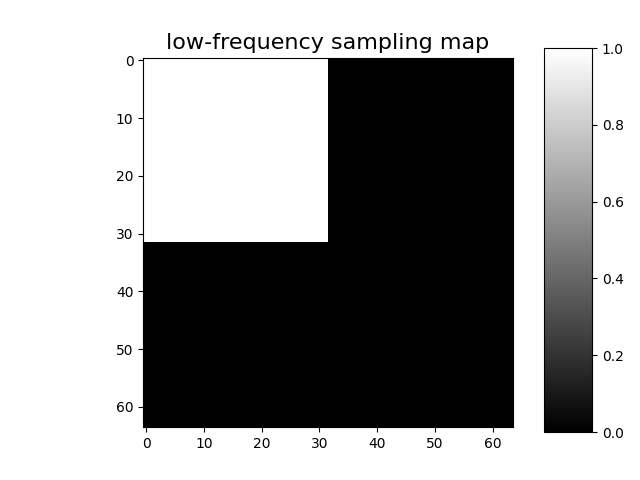
To keep the low-frequency Hadamard coefficients, we choose a sampling map with ones in the top left corner and zeros elsewhere.
import math

und = 4  # undersampling factor
M = h**2 // und  # number of measurements (undersampling factor = 4)

Sampling_map = torch.zeros(h, h)
M_xy = math.ceil(M**0.5)
Sampling_map[:M_xy, :M_xy] = 1

imagesc(Sampling_map, "low-frequency sampling map")
/home/docs/checkouts/readthedocs.org/user_builds/spyrit/envs/2.4.0/lib/python3.11/site-packages/matplotlib/cbook.py:684: DeprecationWarning: __array__ implementation doesn't accept a copy keyword, so passing copy=False failed. __array__ must implement 'dtype' and 'copy' keyword arguments. To learn more, see the migration guide https://numpy.org/devdocs/numpy_2_0_migration_guide.html#adapting-to-changes-in-the-copy-keyword
  x = np.array(x, subok=True, copy=copy)
After permutation of the full Hadamard matrix, we keep only its first
M rows
F = spytorch.sort_by_significance(F, Sampling_map, "rows", False)
H = F[:M, :]

print(f"Shape of the measurement matrix: {H.shape}")
Shape of the measurement matrix: torch.Size([1024, 4096])
Then, we instantiate a spyrit.core.meas.Linear measurement operator
Noiseless case
In the noiseless case, we consider the spyrit.core.noise.NoNoise noise
operator
Shape of raw measurements: torch.Size([1, 1, 1024])
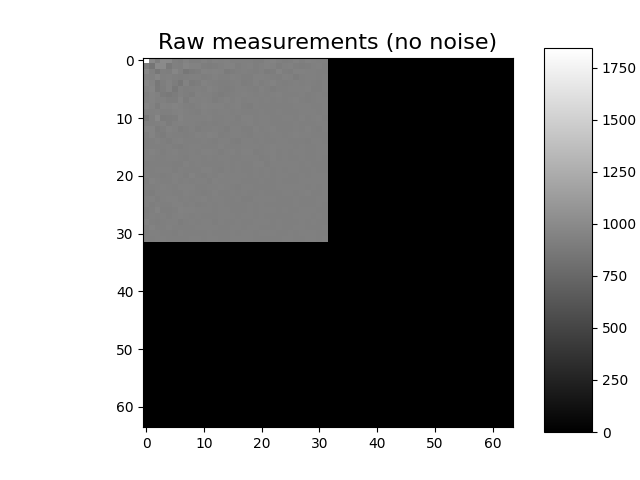
To display the subsampled measurement vector as an image in the transformed
domain, we use the spyrit.core.torch.meas2img() function
# plot
y_plot = spytorch.meas2img(y, Sampling_map)

print(f"Shape of the raw measurement image: {y_plot.shape}")
imagesc(y_plot[0, 0, :, :], "Raw measurements (no noise)")
Shape of the raw measurement image: torch.Size([1, 1, 64, 64])
/home/docs/checkouts/readthedocs.org/user_builds/spyrit/envs/2.4.0/lib/python3.11/site-packages/matplotlib/cbook.py:684: DeprecationWarning: __array__ implementation doesn't accept a copy keyword, so passing copy=False failed. __array__ must implement 'dtype' and 'copy' keyword arguments. To learn more, see the migration guide https://numpy.org/devdocs/numpy_2_0_migration_guide.html#adapting-to-changes-in-the-copy-keyword
  x = np.array(x, subok=True, copy=copy)
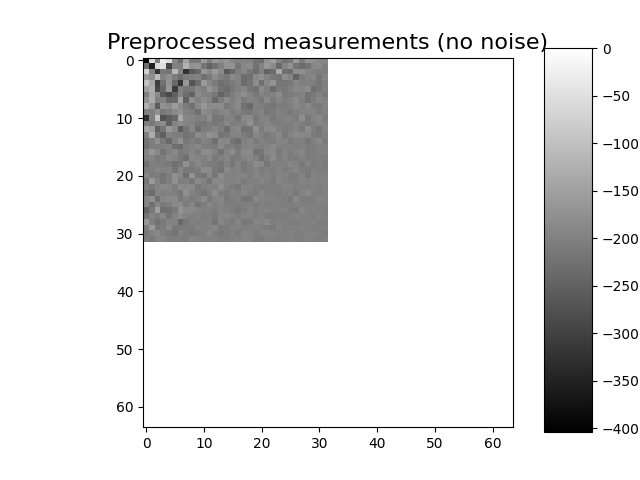
We now compute and plot the preprocessed measurements corresponding to an image in [-1,1]. For details in the preprocessing, see Tutorial 1.
Note
Using spyrit.core.prep.DirectPoisson with \(\alpha = 1\)
allows to compensate for the image normalisation achieved by
spyrit.core.noise.NoNoise.
from spyrit.core.prep import DirectPoisson

prep = DirectPoisson(1.0, meas_op)  # "Undo" the NoNoise operator

m = prep(y)
print(f"Shape of the preprocessed measurements: {m.shape}")

# plot
m_plot = spytorch.meas2img(m, Sampling_map)

print(f"Shape of the preprocessed measurement image: {m_plot.shape}")
imagesc(m_plot[0, 0, :, :], "Preprocessed measurements (no noise)")
Shape of the preprocessed measurements: torch.Size([1, 1, 1024])
Shape of the preprocessed measurement image: torch.Size([1, 1, 64, 64])
/home/docs/checkouts/readthedocs.org/user_builds/spyrit/envs/2.4.0/lib/python3.11/site-packages/matplotlib/cbook.py:684: DeprecationWarning: __array__ implementation doesn't accept a copy keyword, so passing copy=False failed. __array__ must implement 'dtype' and 'copy' keyword arguments. To learn more, see the migration guide https://numpy.org/devdocs/numpy_2_0_migration_guide.html#adapting-to-changes-in-the-copy-keyword
  x = np.array(x, subok=True, copy=copy)
Pseudo inverse
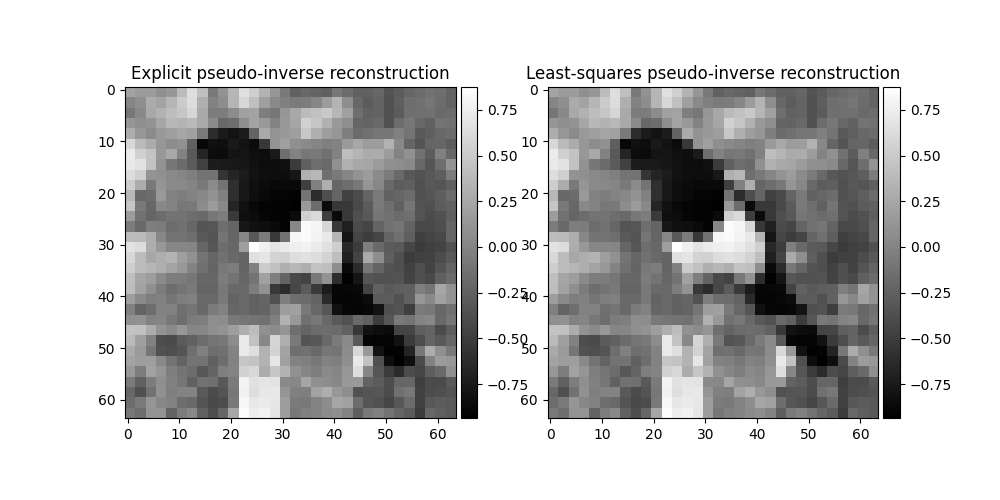
There are two ways to perform the pseudo inverse reconstruction from the
measurements y. The first consists of explicitly computing the
pseudo inverse of the measurement matrix H and applying it to the
measurements. The second computes a least-squares solution using torch.linalg.lstsq()
to compute the pseudo inverse solution.
The choice is made automatically: if the measurement operator has a pseudo-inverse
already computed, it is used; otherwise, the least-squares solution is used.
Note
Generally, the second method is preferred because it is faster and more numerically stable. However, if you will use the pseudo inverse multiple times, it becomes more efficient to compute it explicitly.
First way: explicit computation of the pseudo inverse
We can use the spyrit.core.recon.PseudoInverse class to perform the
pseudo inverse reconstruction from the measurements y.
from spyrit.core.recon import PseudoInverse

# Pseudo-inverse reconstruction operator
recon_op = PseudoInverse()

# Reconstruction
x_rec1 = recon_op(m, meas_op)  # equivalent to: meas_op.pinv(y)
print("Shape of the explicit pseudo-inverse reconstructed image:", x_rec1.shape)
Shape of the explicit pseudo-inverse reconstructed image: torch.Size([1, 1, 64, 64])
Second way: calling pinv method from the Linear operator The code is very similar to the previous case, but we need to make sure the measurement operator has no pseudo-inverse computed. We can also specify regularization parameters for the least-squares solution when calling recon_op. In our case, the pseudo-inverse was computed at initialization of the meas_op object.
print(f"Pseudo-inverse computed: {hasattr(meas_op, 'H_pinv')}")
temp = meas_op.H_pinv  # save the pseudo-inverse
del meas_op.H_pinv  # delete the pseudo-inverse
print(f"Pseudo-inverse computed: {hasattr(meas_op, 'H_pinv')}")

# Reconstruction
x_rec2 = recon_op(m, meas_op, reg="rcond", eta=1e-6)
print("Shape of the least-squares reconstructed image:", x_rec2.shape)

# restore the pseudo-inverse
meas_op.H_pinv = temp
Pseudo-inverse computed: True
Pseudo-inverse computed: False
Shape of the least-squares reconstructed image: torch.Size([1, 1, 64, 64])
Note
This choice is also offered for dynamic measurement operators which are explained in Tutorial 9.
# plot side by side
import matplotlib.pyplot as plt
from spyrit.misc.disp import add_colorbar

fig, (ax1, ax2) = plt.subplots(1, 2, figsize=(10, 5))

im1 = ax1.imshow(x_rec1[0, 0, :, :], cmap="gray")
ax1.set_title("Explicit pseudo-inverse reconstruction")
add_colorbar(im1, "right", size="20%")

im2 = ax2.imshow(x_rec2[0, 0, :, :], cmap="gray")
ax2.set_title("Least-squares pseudo-inverse reconstruction")
add_colorbar(im2, "right", size="20%")
/home/docs/checkouts/readthedocs.org/user_builds/spyrit/envs/2.4.0/lib/python3.11/site-packages/matplotlib/cbook.py:684: DeprecationWarning: __array__ implementation doesn't accept a copy keyword, so passing copy=False failed. __array__ must implement 'dtype' and 'copy' keyword arguments. To learn more, see the migration guide https://numpy.org/devdocs/numpy_2_0_migration_guide.html#adapting-to-changes-in-the-copy-keyword
  x = np.array(x, subok=True, copy=copy)
/home/docs/checkouts/readthedocs.org/user_builds/spyrit/envs/2.4.0/lib/python3.11/site-packages/matplotlib/cbook.py:684: DeprecationWarning: __array__ implementation doesn't accept a copy keyword, so passing copy=False failed. __array__ must implement 'dtype' and 'copy' keyword arguments. To learn more, see the migration guide https://numpy.org/devdocs/numpy_2_0_migration_guide.html#adapting-to-changes-in-the-copy-keyword
  x = np.array(x, subok=True, copy=copy)

<matplotlib.colorbar.Colorbar object at 0x7f3c9f3e2350>
PinvNet Network
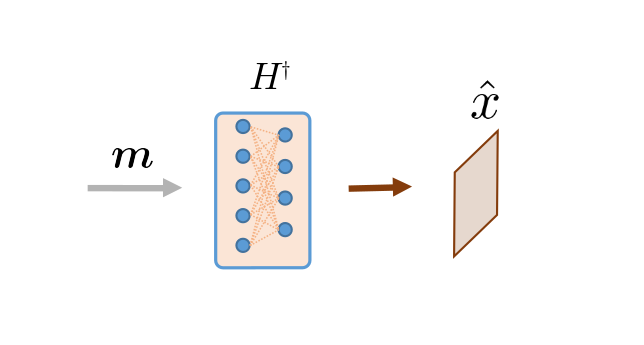
Alternatively, we can consider the spyrit.core.recon.PinvNet class that reconstructs an
image by computing the pseudoinverse solution, which is fed to a neural
networker denoiser. To compute the pseudoinverse solution only, the denoiser
can be set to the identity operator
or equivalently
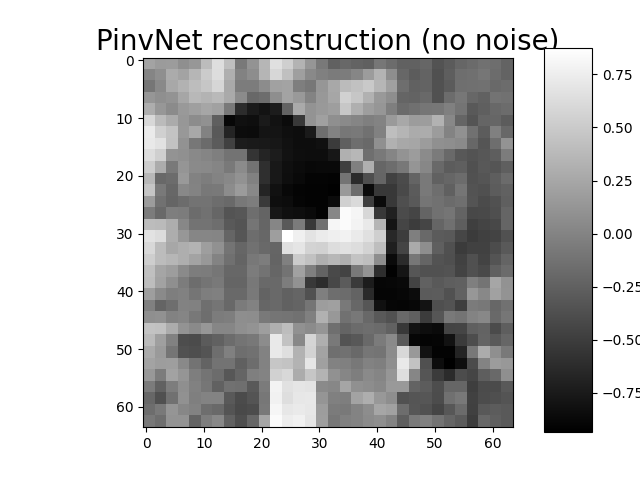
Then, we reconstruct the image from the measurement vector y using the
reconstruct() method.
x_rec = pinv_net.reconstruct(y)
print("Shape of the PinvNet reconstructed image:", x_rec.shape)

# plot
imagesc(x_rec[0, 0, :, :], "PinvNet reconstruction (no noise)", title_fontsize=20)
Shape of the PinvNet reconstructed image: torch.Size([1, 1, 64, 64])
/home/docs/checkouts/readthedocs.org/user_builds/spyrit/envs/2.4.0/lib/python3.11/site-packages/matplotlib/cbook.py:684: DeprecationWarning: __array__ implementation doesn't accept a copy keyword, so passing copy=False failed. __array__ must implement 'dtype' and 'copy' keyword arguments. To learn more, see the migration guide https://numpy.org/devdocs/numpy_2_0_migration_guide.html#adapting-to-changes-in-the-copy-keyword
  x = np.array(x, subok=True, copy=copy)
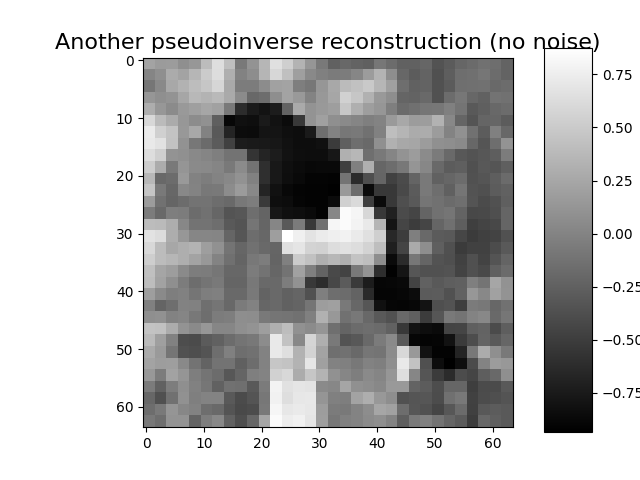
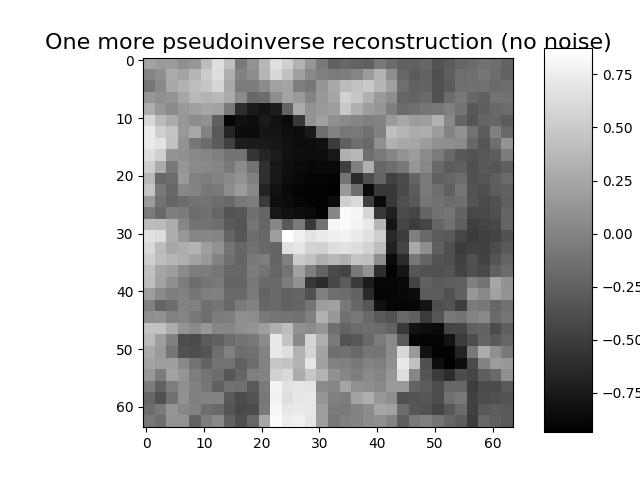
Alternatively, the measurement vector can be simulated using the
acquire() method
y = pinv_net.acquire(x)
x_rec = pinv_net.reconstruct(y)

# plot
imagesc(x_rec[0, 0, :, :], "Another pseudoinverse reconstruction (no noise)")
/home/docs/checkouts/readthedocs.org/user_builds/spyrit/envs/2.4.0/lib/python3.11/site-packages/matplotlib/cbook.py:684: DeprecationWarning: __array__ implementation doesn't accept a copy keyword, so passing copy=False failed. __array__ must implement 'dtype' and 'copy' keyword arguments. To learn more, see the migration guide https://numpy.org/devdocs/numpy_2_0_migration_guide.html#adapting-to-changes-in-the-copy-keyword
  x = np.array(x, subok=True, copy=copy)
Note that the full module pinv_net both simulates noisy measurements
and reconstruct them
Ground-truth image x: torch.Size([1, 1, 64, 64])
Reconstructed x_rec: torch.Size([1, 1, 64, 64])
/home/docs/checkouts/readthedocs.org/user_builds/spyrit/envs/2.4.0/lib/python3.11/site-packages/matplotlib/cbook.py:684: DeprecationWarning: __array__ implementation doesn't accept a copy keyword, so passing copy=False failed. __array__ must implement 'dtype' and 'copy' keyword arguments. To learn more, see the migration guide https://numpy.org/devdocs/numpy_2_0_migration_guide.html#adapting-to-changes-in-the-copy-keyword
  x = np.array(x, subok=True, copy=copy)
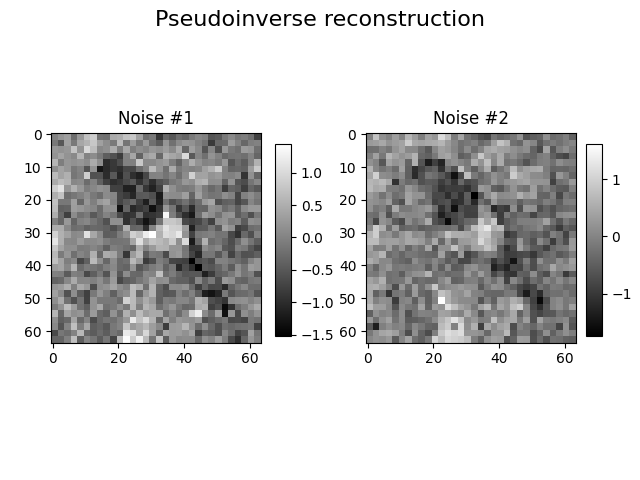
Poisson-corrupted measurement
Here, we consider the spyrit.core.noise.Poisson class
together with a spyrit.core.prep.DirectPoisson
preprocessing operator (see Tutorial 1).
alpha = 10  # maximum number of photons in the image

from spyrit.core.noise import Poisson
from spyrit.misc.disp import imagecomp

noise = Poisson(meas_op, alpha)
prep = DirectPoisson(alpha, meas_op)  # To undo the "Poisson" operator
pinv_net = PinvNet(noise, prep)

x_rec_1 = pinv_net(x)
x_rec_2 = pinv_net(x)
print(f"Ground-truth image x: {x.shape}")
print(f"Reconstructed x_rec: {x_rec.shape}")

# plot
x_plot_1 = x_rec_1[0, 0, :, :]
x_plot_1[:2, :2] = 0.0  # hide the top left "crazy pixel" that collects noise
x_plot_2 = x_rec_2[0, 0, :, :]
x_plot_2[:2, :2] = 0.0  # hide the top left "crazy pixel" that collects noise
imagecomp(x_plot_1, x_plot_2, "Pseudoinverse reconstruction", "Noise #1", "Noise #2")
Ground-truth image x: torch.Size([1, 1, 64, 64])
Reconstructed x_rec: torch.Size([1, 1, 64, 64])
/home/docs/checkouts/readthedocs.org/user_builds/spyrit/envs/2.4.0/lib/python3.11/site-packages/matplotlib/cbook.py:684: DeprecationWarning: __array__ implementation doesn't accept a copy keyword, so passing copy=False failed. __array__ must implement 'dtype' and 'copy' keyword arguments. To learn more, see the migration guide https://numpy.org/devdocs/numpy_2_0_migration_guide.html#adapting-to-changes-in-the-copy-keyword
  x = np.array(x, subok=True, copy=copy)
/home/docs/checkouts/readthedocs.org/user_builds/spyrit/envs/2.4.0/lib/python3.11/site-packages/matplotlib/cbook.py:684: DeprecationWarning: __array__ implementation doesn't accept a copy keyword, so passing copy=False failed. __array__ must implement 'dtype' and 'copy' keyword arguments. To learn more, see the migration guide https://numpy.org/devdocs/numpy_2_0_migration_guide.html#adapting-to-changes-in-the-copy-keyword
  x = np.array(x, subok=True, copy=copy)
As shown in the next tutorial, a denoising neural network can be trained to postprocess the pseudo inverse solution.
Total running time of the script: (0 minutes 3.251 seconds)