Note
Go to the end to download the full example code.
03. Pseudoinverse solution + CNN denoising
This tutorial shows how to simulate measurements and perform image reconstruction using PinvNet (pseudoinverse linear network) with CNN denoising as a last layer. This tutorial is a continuation of the Pseudoinverse solution tutorial but uses a CNN denoiser instead of the identity operator in order to remove artefacts.
The measurement operator is chosen as a Hadamard matrix with positive coefficients, which can be replaced by any matrix.
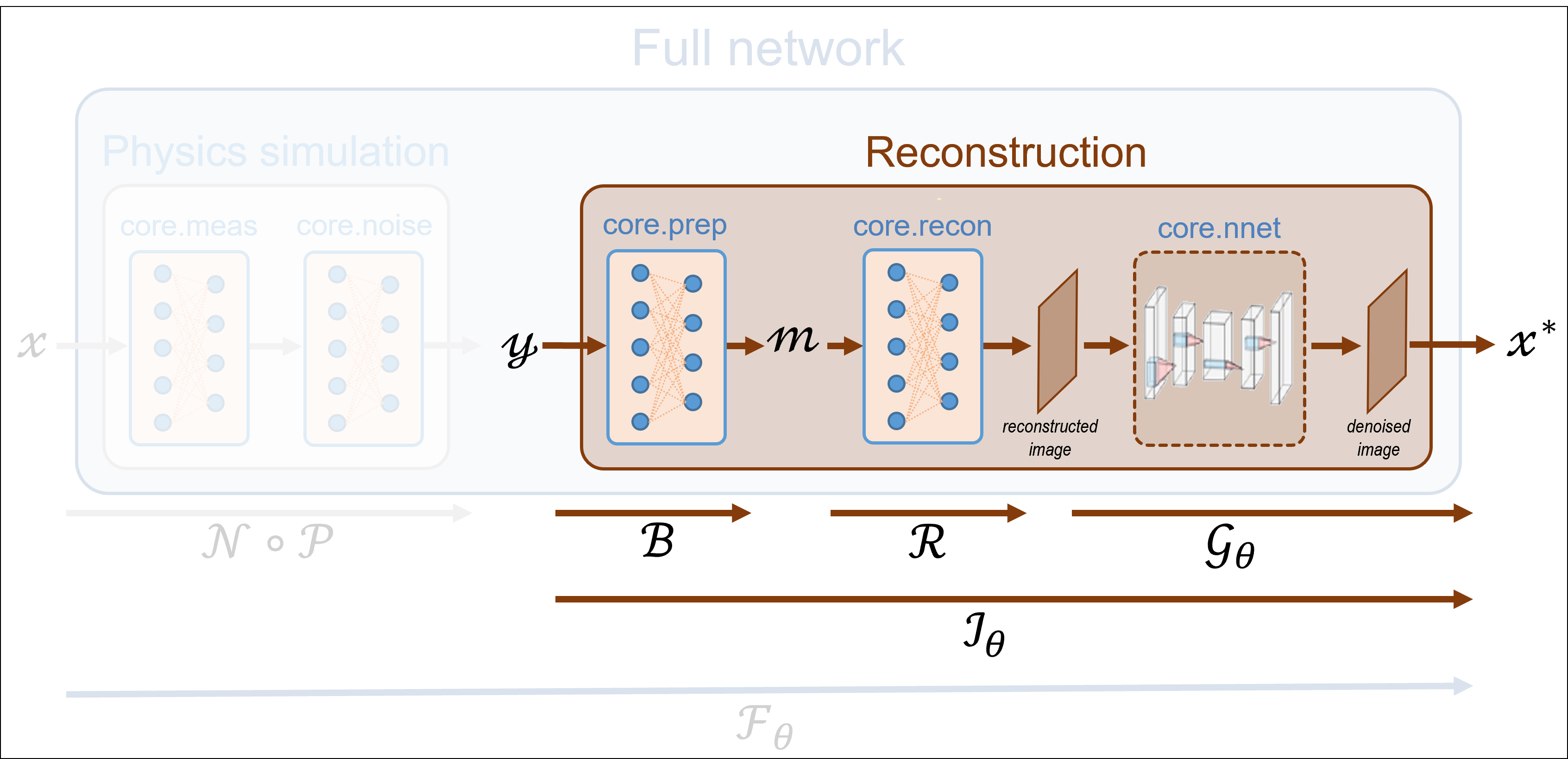
These tutorials load image samples from /images/.
Load a batch of images
Images \(x\) for training expect values in [-1,1]. The images are normalized
using the transform_gray_norm() function.
import os

import torch
import torchvision
import matplotlib.pyplot as plt

import spyrit.core.torch as spytorch
from spyrit.misc.disp import imagesc
from spyrit.misc.statistics import transform_gray_norm

# sphinx_gallery_thumbnail_path = 'fig/tuto3.png'

h = 64  # image size hxh
i = 1  # Image index (modify to change the image)
spyritPath = os.getcwd()
imgs_path = os.path.join(spyritPath, "images/")

# Create a transform for natural images to normalized grayscale image tensors
transform = transform_gray_norm(img_size=h)

# Create dataset and loader (expects class folder 'images/test/')
dataset = torchvision.datasets.ImageFolder(root=imgs_path, transform=transform)
dataloader = torch.utils.data.DataLoader(dataset, batch_size=7)

x, _ = next(iter(dataloader))
print(f"Shape of input images: {x.shape}")

# Select image
x = x[i : i + 1, :, :, :]
x = x.detach().clone()
print(f"Shape of selected image: {x.shape}")
b, c, h, w = x.shape

# plot
imagesc(x[0, 0, :, :], r"$x$ in [-1, 1]")
![$x$ in [-1, 1]](../_images/sphx_glr_tuto_03_pseudoinverse_cnn_linear_001.png)
Shape of input images: torch.Size([7, 1, 64, 64])
Shape of selected image: torch.Size([1, 1, 64, 64])
/home/docs/checkouts/readthedocs.org/user_builds/spyrit/envs/2.4.0/lib/python3.11/site-packages/matplotlib/cbook.py:684: DeprecationWarning: __array__ implementation doesn't accept a copy keyword, so passing copy=False failed. __array__ must implement 'dtype' and 'copy' keyword arguments. To learn more, see the migration guide https://numpy.org/devdocs/numpy_2_0_migration_guide.html#adapting-to-changes-in-the-copy-keyword
  x = np.array(x, subok=True, copy=copy)
Define a measurement operator
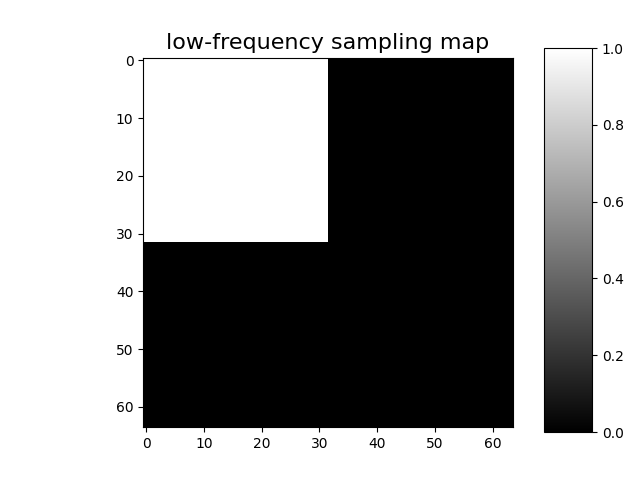
We consider the case where the measurement matrix is the positive
component of a Hadamard matrix and the sampling operator preserves only
the first M low-frequency coefficients
(see Positive Hadamard matrix for full explantion).
import math

F = spytorch.walsh2_matrix(h)
F = torch.max(F, torch.zeros_like(F))

und = 4  # undersampling factor
M = h**2 // und  # number of measurements (undersampling factor = 4)

Sampling_map = torch.zeros(h, h)
M_xy = math.ceil(M**0.5)
Sampling_map[:M_xy, :M_xy] = 1

imagesc(Sampling_map, "low-frequency sampling map")
/home/docs/checkouts/readthedocs.org/user_builds/spyrit/envs/2.4.0/lib/python3.11/site-packages/matplotlib/cbook.py:684: DeprecationWarning: __array__ implementation doesn't accept a copy keyword, so passing copy=False failed. __array__ must implement 'dtype' and 'copy' keyword arguments. To learn more, see the migration guide https://numpy.org/devdocs/numpy_2_0_migration_guide.html#adapting-to-changes-in-the-copy-keyword
  x = np.array(x, subok=True, copy=copy)
After permutation of the full Hadamard matrix, we keep only its first
M rows
F = spytorch.sort_by_significance(F, Sampling_map, "rows", False)
H = F[:M, :]

print(f"Shape of the measurement matrix: {H.shape}")
Shape of the measurement matrix: torch.Size([1024, 4096])
Then, we instantiate a spyrit.core.meas.Linear measurement operator
Noiseless case
In the noiseless case, we consider the spyrit.core.noise.NoNoise noise
operator
Shape of raw measurements: torch.Size([1, 1, 1024])
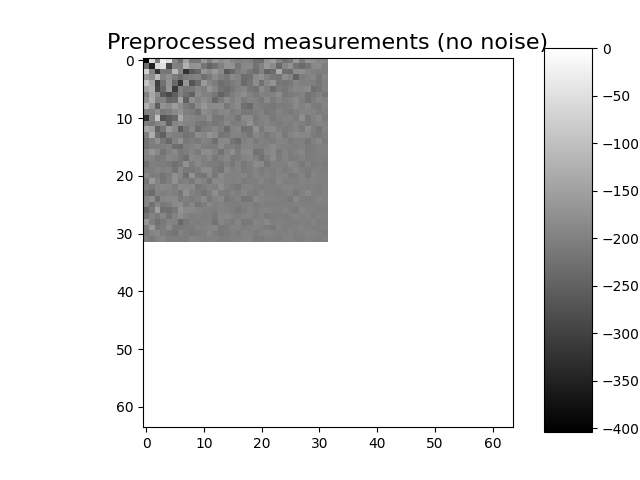
We now compute and plot the preprocessed measurements corresponding to an image in [-1,1]
from spyrit.core.prep import DirectPoisson

prep = DirectPoisson(N0, meas_op)  # "Undo" the NoNoise operator

m = prep(y)
print(f"Shape of the preprocessed measurements: {m.shape}")
Shape of the preprocessed measurements: torch.Size([1, 1, 1024])
To display the subsampled measurement vector as an image in the transformed
domain, we use the spyrit.core.torch.meas2img() function
# plot
m_plot = spytorch.meas2img(m, Sampling_map)
print(f"Shape of the preprocessed measurement image: {m_plot.shape}")

imagesc(m_plot[0, 0, :, :], "Preprocessed measurements (no noise)")
Shape of the preprocessed measurement image: torch.Size([1, 1, 64, 64])
/home/docs/checkouts/readthedocs.org/user_builds/spyrit/envs/2.4.0/lib/python3.11/site-packages/matplotlib/cbook.py:684: DeprecationWarning: __array__ implementation doesn't accept a copy keyword, so passing copy=False failed. __array__ must implement 'dtype' and 'copy' keyword arguments. To learn more, see the migration guide https://numpy.org/devdocs/numpy_2_0_migration_guide.html#adapting-to-changes-in-the-copy-keyword
  x = np.array(x, subok=True, copy=copy)
PinvNet Network
We consider the spyrit.core.recon.PinvNet class that reconstructs an
image by computing the pseudoinverse solution, which is fed to a neural
network denoiser. To compute the pseudoinverse solution only, the denoiser
can be set to the identity operator
or equivalently
Then, we reconstruct the image from the measurement vector y using the
reconstruct() method
x_rec = pinv_net.reconstruct(y)
Removing artefacts with a CNN
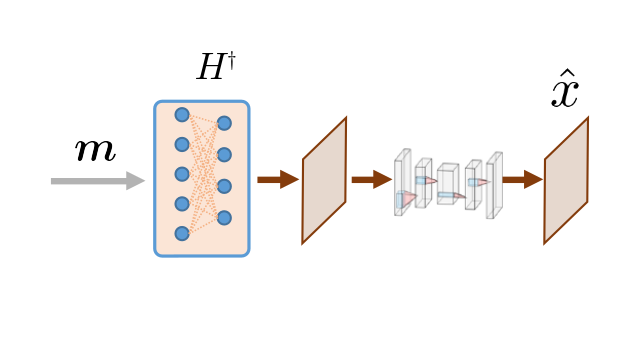
Artefacts can be removed by selecting a neural network denoiser
(last layer of PinvNet). We select a simple CNN using the
spyrit.core.nnet.ConvNet class, but this can be replaced by any
neural network (eg. UNet from spyrit.core.nnet.Unet).
from spyrit.core.nnet import ConvNet
from spyrit.core.train import load_net

# Define PInvNet with ConvNet denoising layer
denoi = ConvNet()
pinv_net_cnn = PinvNet(noise, prep, denoi)

# Send to GPU if available
device = torch.device("cuda:0" if torch.cuda.is_available() else "cpu")
print("Using device:", device)
pinv_net_cnn = pinv_net_cnn.to(device)
Using device: cpu
As an example, we use a simple ConvNet that has been pretrained using STL-10 dataset. We download the pretrained weights and load them into the network.
from spyrit.misc.load_data import download_girder

# Load pretrained model
url = "https://tomoradio-warehouse.creatis.insa-lyon.fr/api/v1"
dataID = "67221889f03a54733161e963"  # unique ID of the file
local_folder = "./model/"
data_name = "tuto3_pinv-net_cnn_stl10_N0_1_N_64_M_1024_epo_30_lr_0.001_sss_10_sdr_0.5_bs_512_reg_1e-07_light.pth"
# download the model and save it in the local folder
model_cnn_path = download_girder(url, dataID, local_folder, data_name)

# Load model weights
load_net(model_cnn_path, pinv_net_cnn, device, False)
/home/docs/checkouts/readthedocs.org/user_builds/spyrit/envs/2.4.0/lib/python3.11/site-packages/girder_client/__init__.py:1: DeprecationWarning: pkg_resources is deprecated as an API. See https://setuptools.pypa.io/en/latest/pkg_resources.html
  from pkg_resources import DistributionNotFound, get_distribution
/home/docs/checkouts/readthedocs.org/user_builds/spyrit/envs/2.4.0/lib/python3.11/site-packages/pkg_resources/__init__.py:3149: DeprecationWarning: Deprecated call to `pkg_resources.declare_namespace('sphinxcontrib')`.
Implementing implicit namespace packages (as specified in PEP 420) is preferred to `pkg_resources.declare_namespace`. See https://setuptools.pypa.io/en/latest/references/keywords.html#keyword-namespace-packages
  declare_namespace(pkg)
Local folder not found, creating it... done.
Downloading tuto3_pinv-net_cnn_stl10_N0_1_N_64_M_1024_epo_30_lr_0.001_sss_10_sdr_0.5_bs_512_reg_1e-07_light.pth...
Downloading tuto3_pinv-net_cnn_stl10_N0_1_N_64_M_1024_epo_30_lr_0.001_sss_10_sdr_0.5_bs_512_reg_1e-07_light.pth... done.
Model Loaded: /home/docs/checkouts/readthedocs.org/user_builds/spyrit/checkouts/2.4.0/tutorial/model/tuto3_pinv-net_cnn_stl10_N0_1_N_64_M_1024_epo_30_lr_0.001_sss_10_sdr_0.5_bs_512_reg_1e-07_light.pth
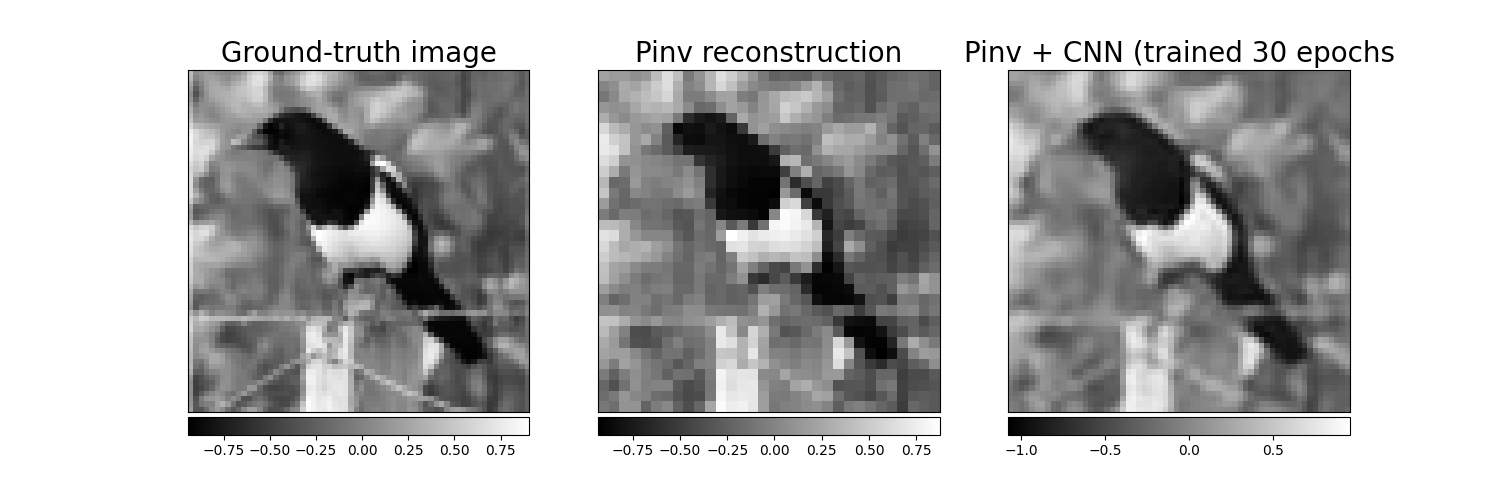
We now reconstruct the image using PinvNet with pretrained CNN denoising and plot results side by side with the PinvNet without denoising
from spyrit.misc.disp import add_colorbar, noaxis

with torch.no_grad():
    x_rec_cnn = pinv_net_cnn.reconstruct(y.to(device))
    x_rec_cnn = pinv_net_cnn(x.to(device))

# plot
f, (ax1, ax2, ax3) = plt.subplots(1, 3, figsize=(15, 5))

im1 = ax1.imshow(x[0, 0, :, :], cmap="gray")
ax1.set_title("Ground-truth image", fontsize=20)
noaxis(ax1)
add_colorbar(im1, "bottom", size="20%")

im2 = ax2.imshow(x_rec[0, 0, :, :], cmap="gray")
ax2.set_title("Pinv reconstruction", fontsize=20)
noaxis(ax2)
add_colorbar(im2, "bottom", size="20%")

im3 = ax3.imshow(x_rec_cnn.cpu()[0, 0, :, :], cmap="gray")
ax3.set_title(f"Pinv + CNN (trained 30 epochs", fontsize=20)
noaxis(ax3)
add_colorbar(im3, "bottom", size="20%")

plt.show()
/home/docs/checkouts/readthedocs.org/user_builds/spyrit/envs/2.4.0/lib/python3.11/site-packages/matplotlib/cbook.py:684: DeprecationWarning: __array__ implementation doesn't accept a copy keyword, so passing copy=False failed. __array__ must implement 'dtype' and 'copy' keyword arguments. To learn more, see the migration guide https://numpy.org/devdocs/numpy_2_0_migration_guide.html#adapting-to-changes-in-the-copy-keyword
  x = np.array(x, subok=True, copy=copy)
/home/docs/checkouts/readthedocs.org/user_builds/spyrit/envs/2.4.0/lib/python3.11/site-packages/matplotlib/cbook.py:684: DeprecationWarning: __array__ implementation doesn't accept a copy keyword, so passing copy=False failed. __array__ must implement 'dtype' and 'copy' keyword arguments. To learn more, see the migration guide https://numpy.org/devdocs/numpy_2_0_migration_guide.html#adapting-to-changes-in-the-copy-keyword
  x = np.array(x, subok=True, copy=copy)
/home/docs/checkouts/readthedocs.org/user_builds/spyrit/envs/2.4.0/lib/python3.11/site-packages/matplotlib/cbook.py:684: DeprecationWarning: __array__ implementation doesn't accept a copy keyword, so passing copy=False failed. __array__ must implement 'dtype' and 'copy' keyword arguments. To learn more, see the migration guide https://numpy.org/devdocs/numpy_2_0_migration_guide.html#adapting-to-changes-in-the-copy-keyword
  x = np.array(x, subok=True, copy=copy)
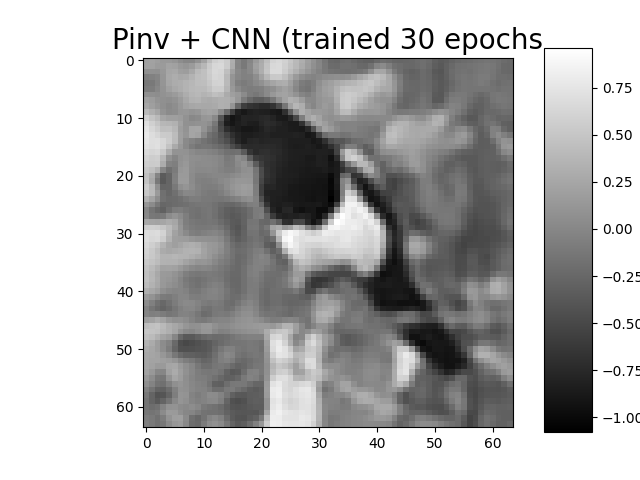
We show the best result again (tutorial thumbnail purpose)
# Plot
imagesc(
    x_rec_cnn.cpu()[0, 0, :, :], f"Pinv + CNN (trained 30 epochs", title_fontsize=20
)
/home/docs/checkouts/readthedocs.org/user_builds/spyrit/envs/2.4.0/lib/python3.11/site-packages/matplotlib/cbook.py:684: DeprecationWarning: __array__ implementation doesn't accept a copy keyword, so passing copy=False failed. __array__ must implement 'dtype' and 'copy' keyword arguments. To learn more, see the migration guide https://numpy.org/devdocs/numpy_2_0_migration_guide.html#adapting-to-changes-in-the-copy-keyword
  x = np.array(x, subok=True, copy=copy)
In the next tutorial, we will show how to train PinvNet + CNN denoiser.
Total running time of the script: (0 minutes 3.515 seconds)