Note
Go to the end to download the full example code.
02. Noise operators
This tutorial shows how to use noise operators using the spyrit.core.noise submodule.
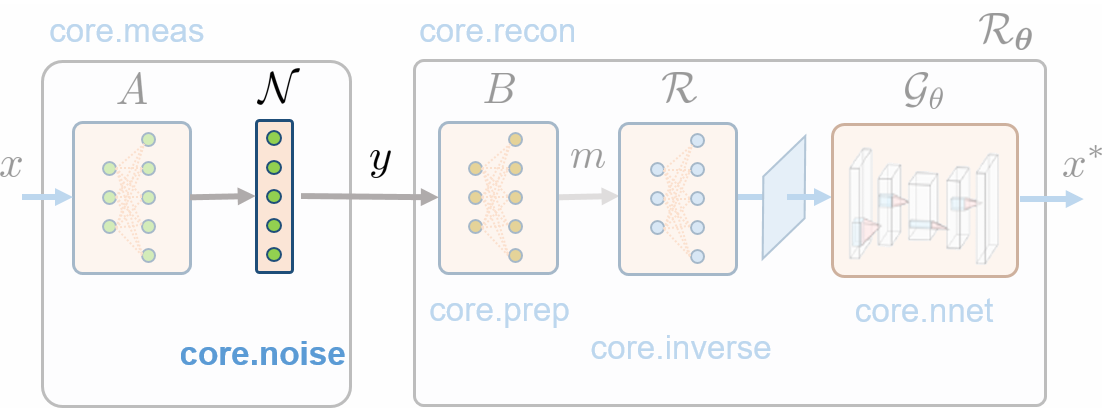
Load a batch of images
We load a batch of images from the /images/ folder. Using the
transform_gray_norm() function with the normalize=False
argument returns images with values in (0,1).
import os

import torch
import torchvision
import matplotlib.pyplot as plt

from spyrit.misc.disp import imagesc
from spyrit.misc.statistics import transform_gray_norm

spyritPath = os.getcwd()
imgs_path = os.path.join(spyritPath, "images/")

# Grayscale images of size 64 x 64, no normalization to keep values in (0,1)
transform = transform_gray_norm(img_size=64, normalize=False)

# Create dataset and loader (expects class folder 'images/test/')
dataset = torchvision.datasets.ImageFolder(root=imgs_path, transform=transform)
dataloader = torch.utils.data.DataLoader(dataset, batch_size=7)

x, _ = next(iter(dataloader))
print(f"Shape of input images: {x.shape}")
Shape of input images: torch.Size([7, 1, 64, 64])
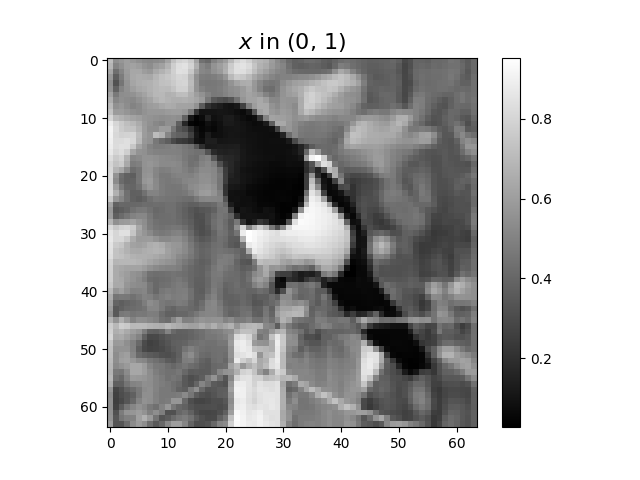
We select the first image in the batch and plot it.
i_plot = 1
imagesc(x[i_plot, 0, :, :], r"$x$ in (0, 1)")
/home/docs/checkouts/readthedocs.org/user_builds/spyrit/envs/3.1.1/lib/python3.11/site-packages/matplotlib/cbook.py:684: DeprecationWarning: __array__ implementation doesn't accept a copy keyword, so passing copy=False failed. __array__ must implement 'dtype' and 'copy' keyword arguments. To learn more, see the migration guide https://numpy.org/devdocs/numpy_2_0_migration_guide.html#adapting-to-changes-in-the-copy-keyword
  x = np.array(x, subok=True, copy=copy)
Gaussian noise
We consider additive Gaussian noise,
where \(\mathcal{N}(\mu, \sigma^2)\) is a Gaussian distribution with mean \(\mu\) and variance \(\sigma^2\), and \(z\) is the noiseless image. The larger \(\sigma\), the lower the signal-to-noise ratio.
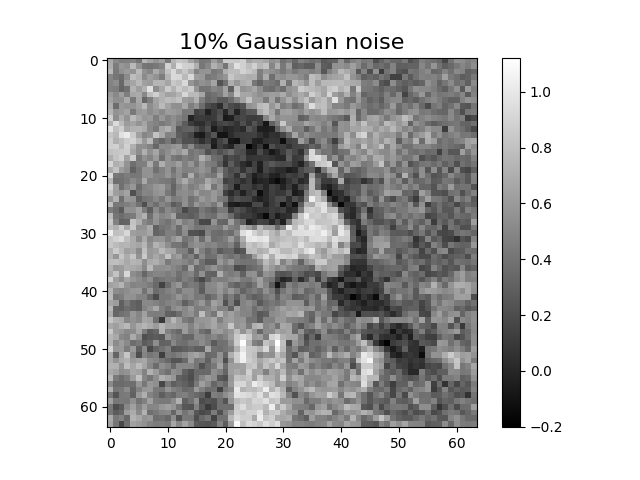
To add 10% Gaussian noise, we instantiate a spyrit.core.noise
operator with sigma=0.1.
/home/docs/checkouts/readthedocs.org/user_builds/spyrit/envs/3.1.1/lib/python3.11/site-packages/matplotlib/cbook.py:684: DeprecationWarning: __array__ implementation doesn't accept a copy keyword, so passing copy=False failed. __array__ must implement 'dtype' and 'copy' keyword arguments. To learn more, see the migration guide https://numpy.org/devdocs/numpy_2_0_migration_guide.html#adapting-to-changes-in-the-copy-keyword
  x = np.array(x, subok=True, copy=copy)
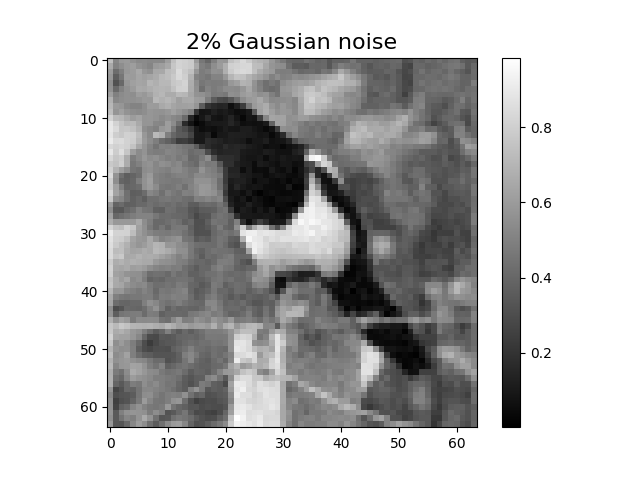
To add 2% Gaussian noise, we update the class attribute sigma.
noise_op.sigma = 0.02
x_noisy = noise_op(x)

imagesc(x_noisy[1, 0, :, :], r"2% Gaussian noise")
/home/docs/checkouts/readthedocs.org/user_builds/spyrit/envs/3.1.1/lib/python3.11/site-packages/matplotlib/cbook.py:684: DeprecationWarning: __array__ implementation doesn't accept a copy keyword, so passing copy=False failed. __array__ must implement 'dtype' and 'copy' keyword arguments. To learn more, see the migration guide https://numpy.org/devdocs/numpy_2_0_migration_guide.html#adapting-to-changes-in-the-copy-keyword
  x = np.array(x, subok=True, copy=copy)
Poisson noise
We now consider Poisson noise,
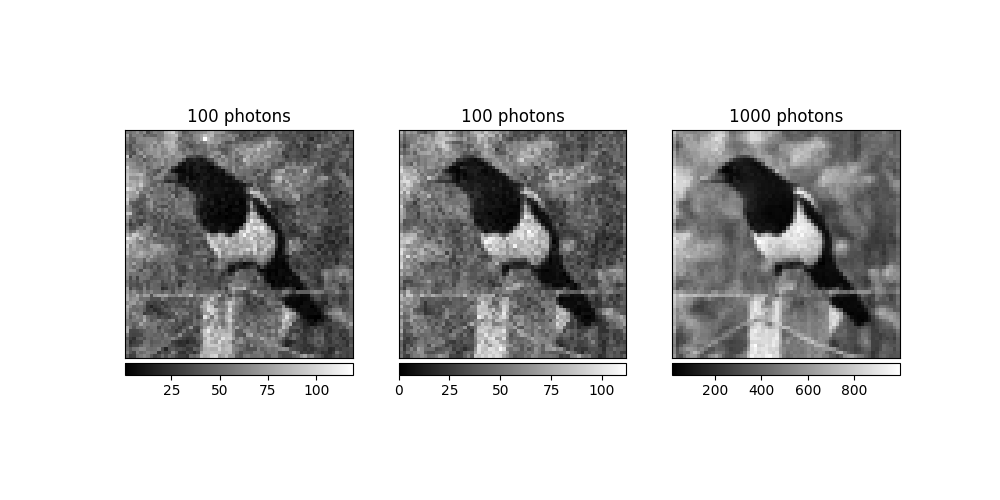
where \(\alpha \ge 0\) is a scalar value that represents the maximum image intensity (in photons). The larger \(\alpha\), the higher the signal-to-noise ratio.
We consider the spyrit.core.noise.Poisson class and set \(\alpha\)
to 100 photons (which corresponds to the Poisson parameter).
from spyrit.core.noise import Poisson
from spyrit.misc.disp import add_colorbar, noaxis

alpha = 100  # number of photons
noise_op = Poisson(alpha)
We simulate two noisy versions of the same images
We now consider the case \(\alpha = 1000\) photons.
We finally plot the noisy images
# plot
f, axs = plt.subplots(1, 3, figsize=(10, 5))
axs[0].set_title("100 photons")
im = axs[0].imshow(y1[1, 0].reshape(64, 64), cmap="gray")
add_colorbar(im, "bottom")

axs[1].set_title("100 photons")
im = axs[1].imshow(y2[1, 0].reshape(64, 64), cmap="gray")
add_colorbar(im, "bottom")

axs[2].set_title("1000 photons")
im = axs[2].imshow(
    y3[
        1,
        0,
    ].reshape(64, 64),
    cmap="gray",
)
add_colorbar(im, "bottom")

noaxis(axs)
/home/docs/checkouts/readthedocs.org/user_builds/spyrit/envs/3.1.1/lib/python3.11/site-packages/matplotlib/cbook.py:684: DeprecationWarning: __array__ implementation doesn't accept a copy keyword, so passing copy=False failed. __array__ must implement 'dtype' and 'copy' keyword arguments. To learn more, see the migration guide https://numpy.org/devdocs/numpy_2_0_migration_guide.html#adapting-to-changes-in-the-copy-keyword
  x = np.array(x, subok=True, copy=copy)
/home/docs/checkouts/readthedocs.org/user_builds/spyrit/envs/3.1.1/lib/python3.11/site-packages/matplotlib/cbook.py:684: DeprecationWarning: __array__ implementation doesn't accept a copy keyword, so passing copy=False failed. __array__ must implement 'dtype' and 'copy' keyword arguments. To learn more, see the migration guide https://numpy.org/devdocs/numpy_2_0_migration_guide.html#adapting-to-changes-in-the-copy-keyword
  x = np.array(x, subok=True, copy=copy)
/home/docs/checkouts/readthedocs.org/user_builds/spyrit/envs/3.1.1/lib/python3.11/site-packages/matplotlib/cbook.py:684: DeprecationWarning: __array__ implementation doesn't accept a copy keyword, so passing copy=False failed. __array__ must implement 'dtype' and 'copy' keyword arguments. To learn more, see the migration guide https://numpy.org/devdocs/numpy_2_0_migration_guide.html#adapting-to-changes-in-the-copy-keyword
  x = np.array(x, subok=True, copy=copy)
As expected the signal-to-noise ratio of the measurement vector is higher for 1,000 photons than for 100 photons
Note
Not only the signal-to-noise, but also the scale of the measurements depends on \(\alpha\), which motivates the introduction of the preprocessing operator.
Total running time of the script: (0 minutes 0.357 seconds)