Note
Go to the end to download the full example code.
05. Denoised Completion Network (DC-Net)
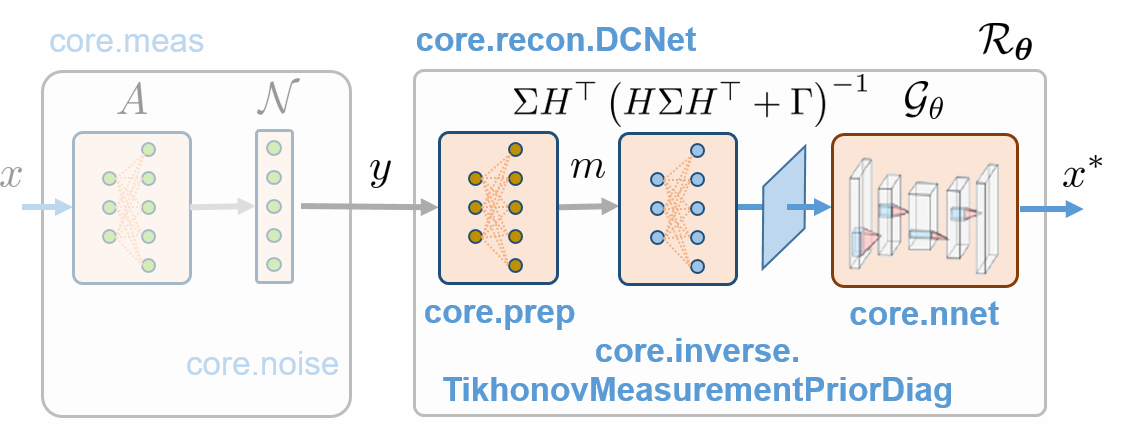
This tutorial shows how to perform image reconstruction using a denoised completion network (DC-Net) [1] with a trainable image denoiser.
Load a batch of images
We load a batch of images from the /images/ folder. Using the
spyrit.misc.statistics.transform_gray_norm() function with the normalize=False
argument returns images with values in (0,1).
import os
import torchvision
import torch.nn
from spyrit.misc.statistics import transform_gray_norm

spyritPath = os.getcwd()
imgs_path = os.path.join(spyritPath, "images/")

# Grayscale images of size 64 x 64, no normalization to keep values in (0,1)
transform = transform_gray_norm(img_size=64, normalize=False)

# Create dataset and loader (expects class folder 'images/test/')
dataset = torchvision.datasets.ImageFolder(root=imgs_path, transform=transform)
dataloader = torch.utils.data.DataLoader(dataset, batch_size=7)

x, _ = next(iter(dataloader))
print(f"Ground-truth images: {x.shape}")
Ground-truth images: torch.Size([7, 1, 64, 64])
We display the second image in the batch
![x[1, 0, :, :]](../_images/sphx_glr_tuto_05_dcnet_001.png)
/home/docs/checkouts/readthedocs.org/user_builds/spyrit/envs/3.1.1/lib/python3.11/site-packages/matplotlib/cbook.py:684: DeprecationWarning: __array__ implementation doesn't accept a copy keyword, so passing copy=False failed. __array__ must implement 'dtype' and 'copy' keyword arguments. To learn more, see the migration guide https://numpy.org/devdocs/numpy_2_0_migration_guide.html#adapting-to-changes-in-the-copy-keyword
  x = np.array(x, subok=True, copy=copy)
Forward operators for split measurements
We consider Poisson noise, i.e., a noisy measurement vector given by
where \(\alpha\) is a scalar value that represents the maximum image intensity (in photons), \(A \colon\, \mathbb{R}_+^{2M\times N}\) is the acquisition matrix that contains the DMD patterns, \(x \in \mathbb{R}^N\) is the signal of interest, \(2M\) is the number of DMD patterns, and \(N\) is the dimension of the signal.
The larger \(\alpha\), the higher the signal-to-noise ratio of the measurements.
The acquisition matrix \(A\) is chosen as a split Hadamard matrix. It is subsampled by a factor of four by retaining the rows that give, statistically, the coefficients with the largest variance. This is achieved by the HadamSplit class (see Tutorial 1.c for details).
First, we download a covariance matrix (for subsampling).
from spyrit.misc.load_data import download_girder

# Get covariance matrix
url = "https://tomoradio-warehouse.creatis.insa-lyon.fr/api/v1"
dataId = "672207cbf03a54733161e95d"
data_folder = "./stat/"

file_abs_path = download_girder(url, dataId, data_folder)
Cov = torch.load(file_abs_path, weights_only=True)
File already exists at ./stat/Cov_64x64.pt
Then, we choose a subsampling factor of four and specify the subsampling strategy using the order attribute. Finally, we set the noise model using the noise_model attribute. We use the spyrit.core.noise.Poisson class and set \(\alpha\) to 100 photons.
from spyrit.core.torch import Cov2Var
from spyrit.core.meas import HadamSplit2d
from spyrit.core.noise import Poisson

M = 64 * 64 // 4
alpha = 100.0  # image intensity

Variance = Cov2Var(Cov)
noise_model = Poisson(alpha)
meas_op = HadamSplit2d(64, M=M, order=Variance, noise_model=noise_model)
We simulate the measurements
y = meas_op(x)
Pseudo inverse solution with preprocessing
We compute the pseudo inverse solution using spyrit.core.recon.PinvNet,
which can include a preprocessing step
We consider the spyrit.core.prep.UnsplitRescale class that intends
to “undo”:
The splitting of an acquisition matrix (see
spyrit.core.meas.LinearSplit)The scaling that controls the SNR of Poisson-corrupted measurements (see
spyrit.core.noise.Poisson).
For this, we use the spyrit.core.prep.UnsplitRescale class that computes
where \(y_+ = H_+ x\) and \(y_- = H_- x\).
from spyrit.core.recon import PinvNet
from spyrit.core.prep import UnsplitRescale

prep_op = UnsplitRescale(alpha)
pinvnet = PinvNet(meas_op, prep_op)
Use GPU, if available
Using device: cpu
Reconstruction
with torch.no_grad():
    x_pinv = pinvnet.reconstruct(y)
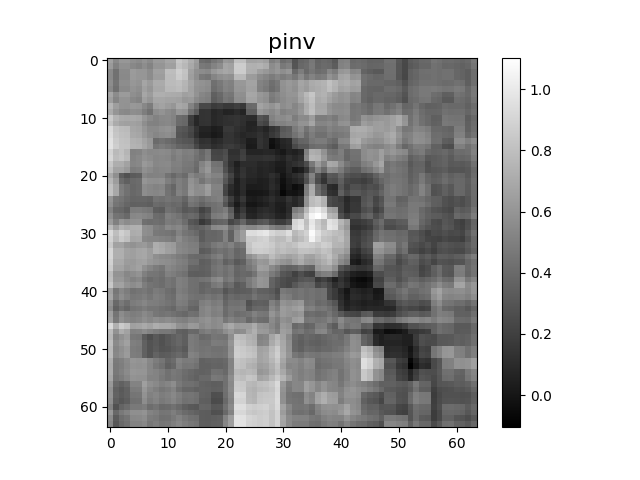
We display the second image in the batch
imagesc(x_pinv[1, 0, :, :].cpu(), "pinv")
/home/docs/checkouts/readthedocs.org/user_builds/spyrit/envs/3.1.1/lib/python3.11/site-packages/matplotlib/cbook.py:684: DeprecationWarning: __array__ implementation doesn't accept a copy keyword, so passing copy=False failed. __array__ must implement 'dtype' and 'copy' keyword arguments. To learn more, see the migration guide https://numpy.org/devdocs/numpy_2_0_migration_guide.html#adapting-to-changes-in-the-copy-keyword
  x = np.array(x, subok=True, copy=copy)
Note
Thanks to preprocessing, the reconstructed image has values in the range (0, 1), like the ground truth image.
Denoised Completion Network (DC-Net)
A DC-Net is based on four sequential steps:
Denoising in the measurement domain.
Estimation of the missing measurements from the denoised ones.
Image-domain mapping.
(Learned) Denoising in the image domain.
Typically, only the last step involves learnable parameters.
Denoised Completion
The first three steps implement denoised completion, which corresponds to Tikhonov regularization. Considering linear measurements \(m = Hx\), where \(H\) is the measurement matrix and \(x\) is the unknown image, it estimates \(x\) from \(y\) by minimizing
where \(\Sigma\) is a covariance prior and \(\Gamma\) is the noise covariance. Denoised completation can be performed using the TikhonovMeasurementPriorDiag class (see documentation for more details).
In practice, it is more convenient to use the spyrit.core.recon.DCNet class, which relies on a forward operator, a preprocessing operator, and a covariance prior.
Note
We divide the covariance by four because it was computed using images with values in the range (-1, 1), whereas our images are in the range (0, 1). Therefore, the covariance is four times larger than expected.
Reconstruction
dcnet = dcnet.to(device)
with torch.no_grad():
    x_dc = dcnet.reconstruct(y)
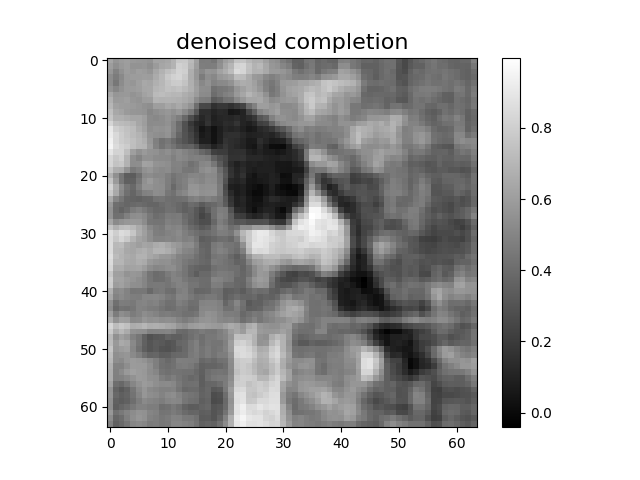
We display the second image in the batch
imagesc(x_dc[1, 0, :, :].cpu(), "denoised completion")
/home/docs/checkouts/readthedocs.org/user_builds/spyrit/envs/3.1.1/lib/python3.11/site-packages/matplotlib/cbook.py:684: DeprecationWarning: __array__ implementation doesn't accept a copy keyword, so passing copy=False failed. __array__ must implement 'dtype' and 'copy' keyword arguments. To learn more, see the migration guide https://numpy.org/devdocs/numpy_2_0_migration_guide.html#adapting-to-changes-in-the-copy-keyword
  x = np.array(x, subok=True, copy=copy)
Note
In this tutorial, the covariance matrix used to define subsampling is also used as prior for reconstruction.
(Learned) Denoising in the image domain
We download the parameters of a (spyrit 2.4) UNet denoiser
from spyrit.misc.load_data import download_girder

url = "https://tomoradio-warehouse.creatis.insa-lyon.fr/api/v1"
model_folder = "./model/"
dataID = "67221559f03a54733161e960"  # unique ID of the file
model_cnn_path = download_girder(url, dataID, model_folder)
Downloading tuto6_dc-net_unet_stl10_N0_100_N_64_M_1024_epo_30_lr_0.001_sss_10_sdr_0.5_bs_512_reg_1e-07_light.pth...
Downloading tuto6_dc-net_unet_stl10_N0_100_N_64_M_1024_epo_30_lr_0.001_sss_10_sdr_0.5_bs_512_reg_1e-07_light.pth... done.
The UNet should be placed in an ordered dictionary and passed to a
nn.Sequential.
SPyRiT 2.4 trains neural networks for images with values in the
range (-1, 1), while SPyRiT 3 assumes images with values in the range (0, 1).
This can be compensated for using spyrit.core.prep.Rerange.
from spyrit.core.prep import Rerange
from typing import OrderedDict
from spyrit.core.nnet import Unet
from spyrit.core.train import load_net

rerange = Rerange((0, 1), (-1, 1))
denoiser = OrderedDict(
    {"rerange": rerange, "denoi": Unet(), "rerange_inv": rerange.inverse()}
)
denoiser = torch.nn.Sequential(denoiser)
load_net(model_cnn_path, denoiser, device, False)
Model Loaded: /home/docs/checkouts/readthedocs.org/user_builds/spyrit/checkouts/3.1.1/tutorial/model/tuto6_dc-net_unet_stl10_N0_100_N_64_M_1024_epo_30_lr_0.001_sss_10_sdr_0.5_bs_512_reg_1e-07_light.pth
To implement denoising in the image domain, we pass the spyrit.core.nnet.Unet denoiser to a spyrit.core.recon.DCNet.
We reconstruct the image
with torch.no_grad():
    x_dcnet = dcnet.reconstruct(y)
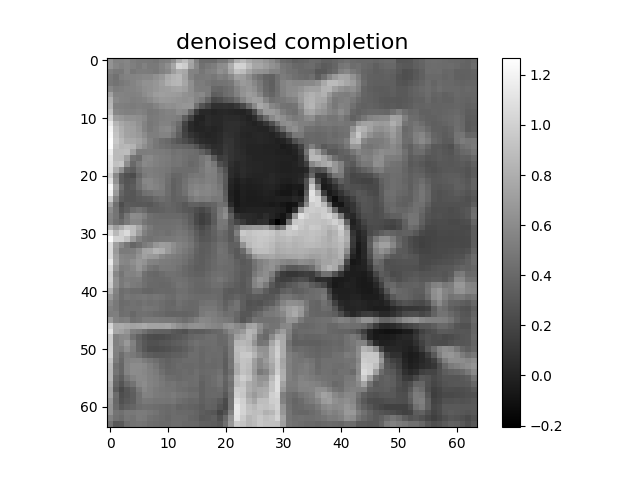
We display the second image in the batch sphinx_gallery_thumbnail_number = 4
im = imagesc(x_dcnet[1, 0, :, :].cpu(), "denoised completion")
/home/docs/checkouts/readthedocs.org/user_builds/spyrit/envs/3.1.1/lib/python3.11/site-packages/matplotlib/cbook.py:684: DeprecationWarning: __array__ implementation doesn't accept a copy keyword, so passing copy=False failed. __array__ must implement 'dtype' and 'copy' keyword arguments. To learn more, see the migration guide https://numpy.org/devdocs/numpy_2_0_migration_guide.html#adapting-to-changes-in-the-copy-keyword
  x = np.array(x, subok=True, copy=copy)
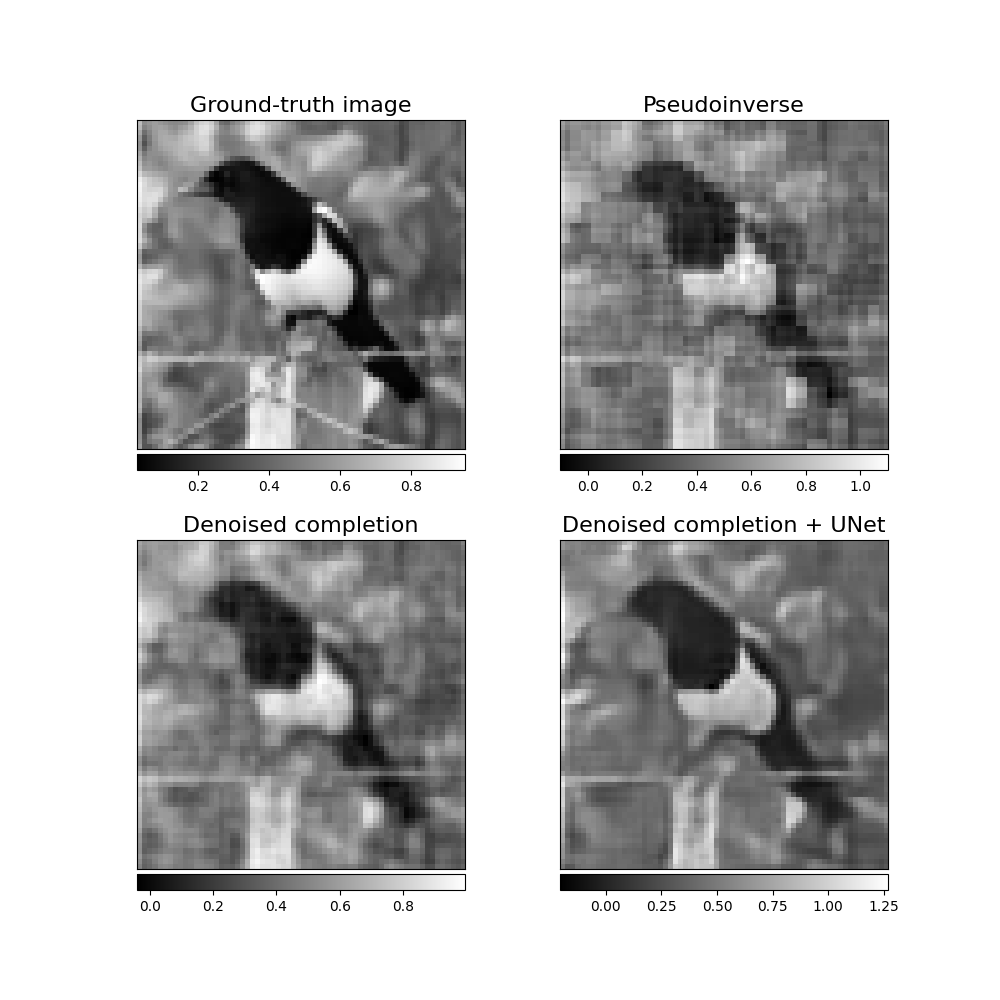
Results
import matplotlib.pyplot as plt
from spyrit.misc.disp import add_colorbar, noaxis

i_im = 1

f, axs = plt.subplots(2, 2, figsize=(10, 10))

# Plot the ground-truth image
im1 = axs[0, 0].imshow(x[i_im, 0, :, :], cmap="gray")
axs[0, 0].set_title("Ground-truth image", fontsize=16)
noaxis(axs[0, 0])
add_colorbar(im1, "bottom")

# Plot the pseudo inverse solution
im2 = axs[0, 1].imshow(x_pinv.cpu()[i_im, 0, :, :], cmap="gray")
axs[0, 1].set_title("Pseudoinverse", fontsize=16)
noaxis(axs[0, 1])
add_colorbar(im2, "bottom")

# Plot the solution obtained from denoised completion
im3 = axs[1, 0].imshow(x_dc.cpu()[i_im, 0, :, :], cmap="gray")
axs[1, 0].set_title("Denoised completion", fontsize=16)
noaxis(axs[1, 0])
add_colorbar(im3, "bottom")

# Plot the solution obtained from denoised completion with UNet denoising
im4 = axs[1, 1].imshow(x_dcnet.cpu()[i_im, 0, :, :], cmap="gray")
axs[1, 1].set_title("Denoised completion + UNet", fontsize=16)
noaxis(axs[1, 1])
add_colorbar(im4, "bottom")
/home/docs/checkouts/readthedocs.org/user_builds/spyrit/envs/3.1.1/lib/python3.11/site-packages/matplotlib/cbook.py:684: DeprecationWarning: __array__ implementation doesn't accept a copy keyword, so passing copy=False failed. __array__ must implement 'dtype' and 'copy' keyword arguments. To learn more, see the migration guide https://numpy.org/devdocs/numpy_2_0_migration_guide.html#adapting-to-changes-in-the-copy-keyword
  x = np.array(x, subok=True, copy=copy)
/home/docs/checkouts/readthedocs.org/user_builds/spyrit/envs/3.1.1/lib/python3.11/site-packages/matplotlib/cbook.py:684: DeprecationWarning: __array__ implementation doesn't accept a copy keyword, so passing copy=False failed. __array__ must implement 'dtype' and 'copy' keyword arguments. To learn more, see the migration guide https://numpy.org/devdocs/numpy_2_0_migration_guide.html#adapting-to-changes-in-the-copy-keyword
  x = np.array(x, subok=True, copy=copy)
/home/docs/checkouts/readthedocs.org/user_builds/spyrit/envs/3.1.1/lib/python3.11/site-packages/matplotlib/cbook.py:684: DeprecationWarning: __array__ implementation doesn't accept a copy keyword, so passing copy=False failed. __array__ must implement 'dtype' and 'copy' keyword arguments. To learn more, see the migration guide https://numpy.org/devdocs/numpy_2_0_migration_guide.html#adapting-to-changes-in-the-copy-keyword
  x = np.array(x, subok=True, copy=copy)
/home/docs/checkouts/readthedocs.org/user_builds/spyrit/envs/3.1.1/lib/python3.11/site-packages/matplotlib/cbook.py:684: DeprecationWarning: __array__ implementation doesn't accept a copy keyword, so passing copy=False failed. __array__ must implement 'dtype' and 'copy' keyword arguments. To learn more, see the migration guide https://numpy.org/devdocs/numpy_2_0_migration_guide.html#adapting-to-changes-in-the-copy-keyword
  x = np.array(x, subok=True, copy=copy)

<matplotlib.colorbar.Colorbar object at 0x76fac4cc4c50>
While the pseudo inverse reconstruction is pixelized, the solution obtained by denoised completion is smoother. DCNet with UNet provides the best reconstruction.
Note
We refer to spyrit-examples for a comparison of several methods (e.g., pinvNet, DCNet, DRUNet).
Total running time of the script: (0 minutes 4.486 seconds)